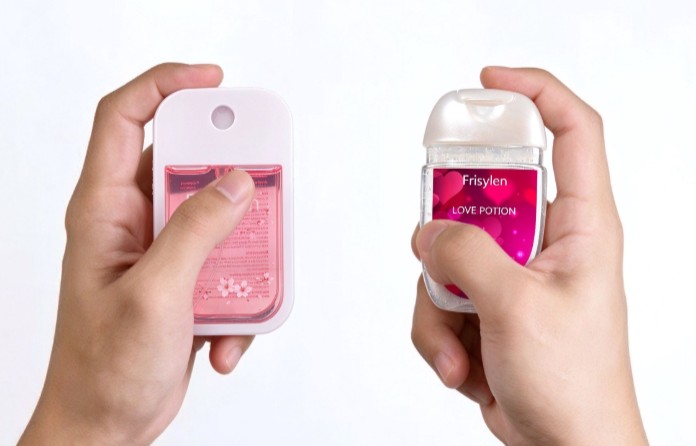
Summary: Gel or spray? It's not just a preference — it's a packaging decision, a user experience decision, and a regulatory decision. We break down the real differences in cost, shelf life, consumer perception, and manufacturing complexity so you can choose the format that fits your brand.
Primary keyword: gel vs spray hand sanitizer
1. Quick Summary: Gel vs Spray at a Glance
If you only read one section, read this one. Below is the decision in a single table; the rest of the article explains each row so you can defend your choice to a partner, a retailer, or your own team.
| Factor | Gel | Spray |
|---|---|---|
| Unit production cost | Lower (standard fill) | Slightly higher (sprayer) |
| Shelf-life risk | Low | Low–medium (valve seal) |
| Consumer perception | Value, familiar | Premium, hygienic |
| Best channel | Retail, family, bulk | DTC, travel, gifts |
| Manufacturing complexity | Low | Medium |
| Skincare positioning | Harder | Easier (light, non-sticky) |
Neither format is "better" in the abstract — they serve different brands. A budget family SKU sold in pallets wants gel. A $14 travel mist sold on Instagram wants spray. The mistake most first-time brands make is picking the format they personally like instead of the one their customer expects. Use the framework in section 6 to map format to audience before you commit to tooling.
Notice that the table deliberately avoids declaring a winner. That is intentional: the right answer is a function of your price point, your channel, and your customer's expectations — not of which bottle looks nicer on your desk. A common failure mode we see is a brand choosing spray for a bulk institutional tender where gel would have won on price, or choosing gel for a premium DTC launch where spray would have justified a higher margin. Let the three columns — cost, perception, channel — settle the debate before you even speak to a manufacturer.
2. Gel Hand Sanitizer: Pros, Cons, and Who It's For
Gel is the default for a reason. It's the format consumers recognize from a decade of use, it fills on standard piston or gravity lines without special hardware, and it ships without the valve-leak anxiety that mist sprayers carry. For a brand optimizing for cost and speed to market, gel is the rational first SKU.
The pros: cheapest unit economics, lowest manufacturing risk, broad acceptance, easy to thicken for a "substantial" feel. The cons: it can feel sticky, it's harder to position as premium, and it's the most commoditized format — your bottle has to work harder to stand out on a crowded shelf.
Gel fits brands targeting families, institutions, and price-sensitive retail. If your go-to-market is "quality sanitizer at a fair price" sold in 250 ml–500 ml pumps, gel is your format. Just invest the savings into a better humectant and a cleaner label so the product doesn't read as generic.
Operationally, gel also tolerates wider shipping and storage temperature swings, which matters if your distribution includes unclimate-controlled warehouses or long ocean transit. The thicker viscosity means less leakage risk from cap failure — a small but real contributor to fewer customer complaints and returns. If your brand's story is "reliable everyday protection at a fair price," gel is not the boring choice; it is the disciplined one, and discipline is what protects margin across a 10,000-unit first order.
3. Spray Hand Sanitizer: The Premium Positioning Play
Spray is where brands go to look different. A fine mist feels modern, hygienic, and non-sticky — and it lets you position at a higher price without changing the formula much. Many of our private label clients launch spray specifically to escape gel commoditization.
The pros: premium perception, light non-greasy feel, great for TSA-friendly travel sizes, excellent for gift and corporate promotions. The cons: the sprayer mechanism costs more than a flip cap, valve quality matters (a cheap valve leaks or clogs), and fill lines need sprayer compatibility.
Spray fits brands targeting travel, gifting, DTC, and premium retail. If your customer buys on Instagram or in an airport shop, spray is the natural choice. Our Mockup Studio renders spray bottles beautifully for launch creative — see the related link below for packaging and bottle-shape options.
One practical note for importers: because the sprayer is a moving part, always request a valve-quality report from your OEM and approve a sealed-sample drop test before mass production. A clogged or leaking sprayer is the fastest way to turn a premium launch into a returns nightmare. Budget for a slightly higher defect-inspection rate on spray lines, and ask your manufacturer about anti-clog filter inserts if you formulate with aloe or other particulates. These are small details, but they are the difference between a spray that feels premium and one that fails in the customer's hand.
4. Cost Comparison: Which Format Is Cheaper to Produce?
On a like-for-like 100 ml bottle, gel is typically the cheaper format. The saving isn't the liquid — ethanol costs the same either way — it's the closure and the fill complexity. A gel flip-top or lotion pump is a mature, high-volume component priced in fractions of a cent. A mist sprayer is a precision valve: more parts, tighter tolerances, and a higher reject rate if your line isn't tuned for it.
Rough economics at a 5,000-unit order: the bottle + closure for gel might run $0.12–$0.20; for spray, $0.20–$0.35, before liquid and label. The liquid itself is comparable. So spray adds maybe $0.08–$0.15 per unit at modest volume — a gap that shrinks as you scale, because sprayer unit price falls faster than caps at high volume.
The strategic point: if you're competing on price, gel protects margin. If you're competing on perception, spray's small premium buys a much stronger shelf story. Don't let a $0.10 part decide your brand — let your customer decide, then engineer cost around them.
There is also a volume effect worth naming: at 1,000 units the spray premium barely registers in your landed cost, but at 20,000 units the cumulative difference can fund an entire upgraded label or a free display box. We routinely model both formats in the same quote so brand owners can see the exact delta at their target order size rather than guessing. The goal is never to minimize cost in isolation — it is to maximize the gap between what the product costs you and what the format lets you charge.
5. Regulatory Difference: Does the Format Change FDA Requirements?
Short answer: no — the active ingredient and claims drive regulation, not the format. A 70% ethanol gel and a 70% ethanol spray face the same OTC monograph, the same Drug Facts panel, and the same facility registration in the US. The EU's cosmetics framework treats both the same way too.
Where format does matter is practical compliance. Spray introduces an aerosol/propellant question: if you use a pressurized propellant can (rare for hand sanitizer, common for surface sprays), you trigger additional transport and labeling rules. A simple pump-mist bottle is not an aerosol and avoids that. Also, sprays must avoid "air sanitizer" or "surface disinfectant" claims — those pull you into a different regulatory category entirely.
So choose format freely; just keep your claims honest and your formula within the monograph. If you're unsure how your target market treats a specific claim, our FDA guide (linked below) walks through the common mistakes that get shipments held.
The one format-linked trap to avoid is the "disinfectant spray" drift: because a mist bottle looks like a surface spray, some brands are tempted to imply it cleans counters. That single claim moves your product out of the hand-sanitizer monograph and into pesticide or disinfectant regulation in most markets — a far heavier burden. Keep the claim scoped to hands, keep the format free, and you retain the simple OTC or cosmetics pathway that makes private label sanitizer such a low-friction category to enter.
6. How to Decide: A Decision Framework for Your Brand
Use this four-question filter before you lock tooling:
- Who is the buyer? Price-sensitive family retail → gel. Image-driven travel/gift/DTC → spray.
- What's the channel? Pallets to distributors → gel. Instagram / airport / corporate swag → spray.
- What's the margin target? Defend every cent → gel. Willing to trade $0.10 for premium feel → spray.
- What's the hero size? 250 ml+ pump → gel. 30–100 ml portable → spray.
Most brands we work with actually launch both eventually — gel as the volume SKU, spray as the hero/marketing SKU. If you can only pick one for a first order, pick the format your customer already expects, then expand once you've validated demand. And if you're stuck, send us your target market and price point; we'll recommend a format in the quote.
Not sure which format fits your brand? We'll tell you in the quote.