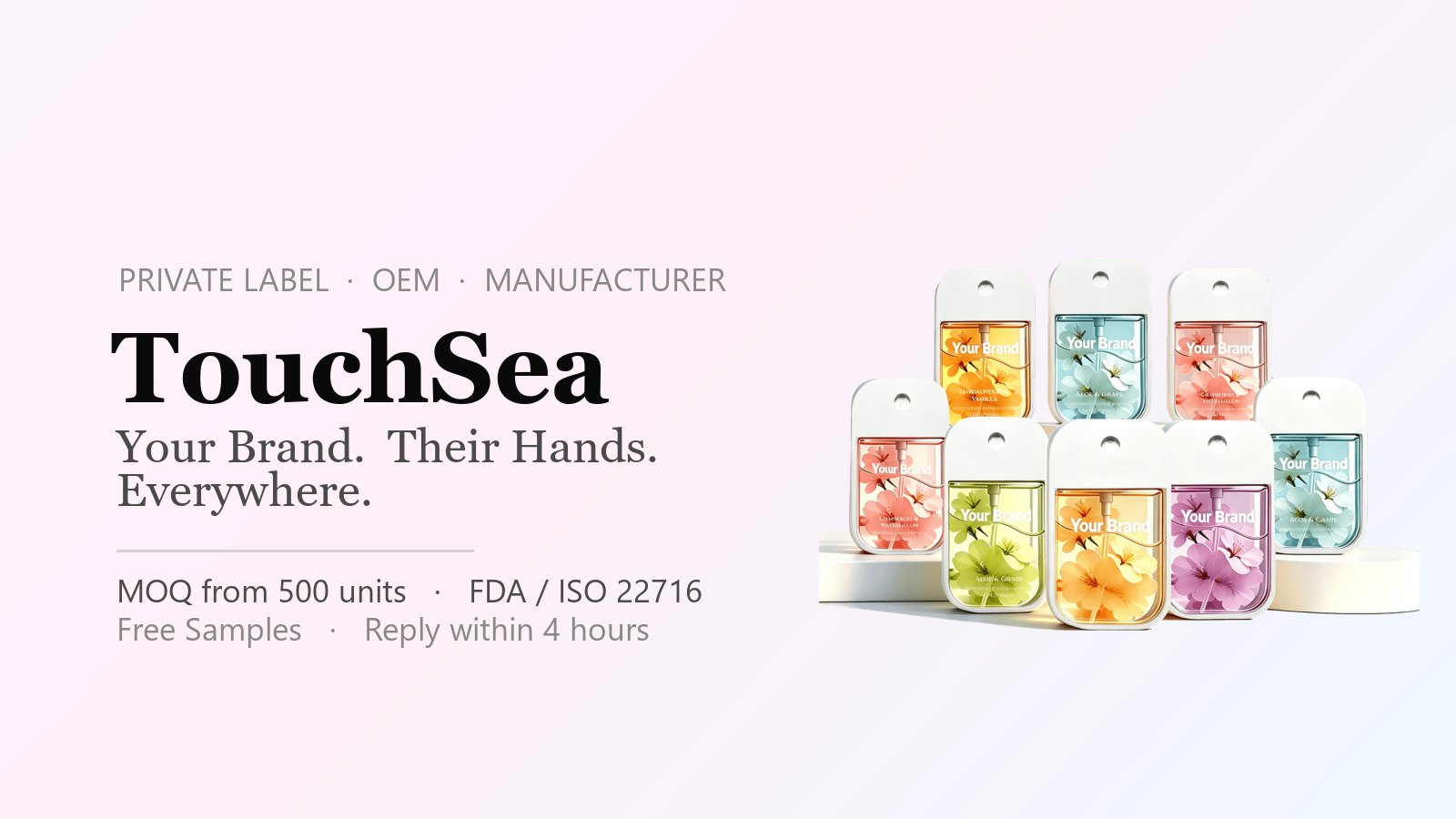
Short answer: Launching a private label hand sanitizer in 2026 comes down to six decisions—pick your market, confirm the regulatory lane (FDA cosmetic vs. OTC drug by intended use), choose a format (spray / gel / foam), lock formula and alcohol concentration, set MOQ and production timeline with a vetted manufacturer, then handle certifications and DDP delivery. The biggest preventable failure is treating it as a "product" project instead of a compliance + supply-chain project.
This guide walks brand owners, Amazon sellers, importers, and corporate-gifting buyers through each step using a factory-side lens—what we see go right, and what stalls shipments.
1. Define Your Market and Buyer
Before sampling a bottle, name the buyer. The format, concentration, and packaging that win in one market can miss in another.
| Market | Typical buyer | Format that fits |
|---|---|---|
| United States | Corporate HR, event planners, Amazon private label sellers | Card-style spray (Touchland-style), 30–38 ml |
| Mexico / LATAM | Wholesalers, back-to-school (Regreso a Clases) | Pocket gel, 30 ml |
| Europe / Australia | Retail chains, importers | Spray or gel, compliant labeling |
Practical note: a card-style 38 ml spray reads as a "brand / gift carrier" in the US; a 30 ml gel reads as a practical back-to-school item in LATAM. The same factory can serve both—only the mold, scent, and MOQ differ.
2. Confirm the Regulatory Baseline (FDA: Cosmetic vs. OTC Drug)
This is where most first-time launches stall. In the US, a hand sanitizer is not automatically an OTC drug. Classification follows intended use, not the ingredient list.
- 【Official position】 If you market the product for preventing or reducing disease (antimicrobial / antiseptic claim), it falls under the FDA OTC drug monograph and carries Drug Facts labeling, NDC, and facility registration requirements.
- 【Industry nuance】 Many private label "hand sanitizer" SKUs are positioned and labeled as cosmetics (a leave-on personal care product) where claims are limited to cleansing / beautifying, not disease prevention. This is a common, legitimate lane—but the line is drawn by what you claim, not what's in the bottle.
- 【Common misconception】 "Alcohol makes it a drug." Incorrect. Intended use and claims decide the lane; an ethanol-based product can sit in either category depending on labeling.
⚠️ Compliance boundary: specific FDA registration numbers, NDC assignments, and current monograph status change—verify against the latest FDA guidance and your registered facility before printing labels. (See also our companion piece Hand Sanitizer: US FDA OTC Drug vs Cosmetic for the deep dive.) This article does not constitute legal advice.
3. Choose the Format — Spray, Gel, or Foam
Your format drives mold cost, fill line, and user experience. The three are not interchangeable on the production floor.
- Spray: fast-drying, non-sticky, ideal for on-the-go and card-style branding. Our card spray runs a 68%–75% ethanol range, concentration customizable per formula.
- Gel: familiar, less likely to be inhaled, easy to control on hands; our pocket gel runs 78% alcohol.
- Foam: premium feel, higher packaging complexity—best when the brand wants a differentiated dispenser.
For a side-by-side decision table and travel/TSA notes, see our Gel vs Spray vs Foam guide (internal link: launching shortly).
4. Formula and Alcohol Concentration
Buyers often ask "what percentage kills the most germs?" The honest answer: effectiveness depends on the claimed use, the formula, and third-party testing—not a single headline number. Reputable manufacturers formulate within recognized ethanol ranges and provide MSDS per scent.
- Spray: 68%–75% ethanol (customizable for large orders)
- Gel: 78% alcohol
- Scent library: 10+ off-the-shelf options (Peach, Coconut, Mint, Lavender, Aloe, Custom, etc.)
Do not publish unverified efficacy claims (e.g., "99.9%"). Keep claims aligned with your regulatory lane and supporting test data.
5. Design, Branding, and Mockups
Private label lives or dies on shelf presence. Key decisions:
- Bottle / card mold: card-style spray vs. pocket bottle vs. oval/trapezoid gel
- Logo & print: AI or PNG artwork; a 3D mockup can typically be turned around in minutes after artwork is received
- Silicone sleeve upsell: a matching sleeve (MOQ 200 pcs) turns a commodity into a gift
One tip from the factory floor: decide print method early. Hot-stamping (foil) usually carries a higher MOQ than standard screen print—bake that into your launch timeline.
6. MOQ, Pricing, and Production Timeline
| Tier | MOQ | Unit price (EXW, reference) | Lead time |
|---|---|---|---|
| Ready stock (no custom logo) | 100 pcs | from USD 0.80 / pc | 48 hours |
| Private label (with logo) | 500 pcs | from USD 0.56 / pc | 7–12 working days |
| Silicone sleeve add-on | 200 pcs | from USD 0.30 / pc | — |
| Artwork tooling | — | USD 70 / color (first order only) | — |
Payment norm: 30% deposit in advance, balance against copy of B/L. Pricing above is a reference baseline (verify against current quote); do not treat it as a live quote.
For orders below 500 pcs that still want a logo, the standard path is the ready-stock program (100 pcs, no logo)—the 500 pcs threshold is where private label printing becomes economical.
7. Certifications and Quality
For cross-border B2B, buyers screen on paperwork before they screen on price. A credible manufacturer should be able to show:
- FDA cosmetic registration (MoCRA framework)
- ISO 9001 quality management
- GMP (Good Manufacturing Practice)
- CE marking
- MSDS per scent
Red flag for buyers: a factory that cannot produce certs or volunteers random certificate numbers from memory. Ask for the actual document; verify the registration status independently. (Certificate numbers/validity are provided case-by-case—confirm with the supplier directly.)
8. Logistics and Delivery
Sensitive goods (alcohol-based) need a freight lane that actually clears customs.
- DDP (Delivered Duty Paid) consolidates freight + duty + last-mile into one door price—popular with first-time importers because the landed cost is known up front.
- Sensitive-cargo (e.g., expedited ocean / air-sensitive routes) is the usual channel.
- A supplier that offers a 100% refund if held by customs under DDP is shouldering risk most factories won't—worth weighting heavily when comparing quotes.
9. How to Select a Manufacturing Partner
A short factory-side checklist:
- Vertical integration — in-house mold + filling means fewer handoffs and steadier quality. A 300,000-class clean filling line is a strong signal.
- Track record — years as a verified manufacturer, export count, and on-time delivery rate.
- Sampling speed — can they show a 3D mockup fast? Slow mockups usually mean slow production.
- Paperwork — certs on file, MSDS per scent, clean compliance language.
- Honest MOQ — a partner who tells you "under 500 pcs, go ready-stock" is protecting your margin, not losing a sale.
Our own setup: 7-year Verified Manufacturer, in-house mold + 300,000-class clean filling, FDA cosmetic registration / ISO 9001 / GMP / CE on file, DDP with customs-refund backing. Explore the Private Label Hand Sanitizer Spray and Private Label Hand Sanitizer Gel product pages for specs.
FAQ
Q: Do I need FDA approval to sell private label hand sanitizer in the US? A: Not necessarily "approval"—classification depends on intended use. Cosmetic-positioned SKUs follow cosmetic rules; antimicrobial/disease-prevention claims trigger the OTC drug monograph, NDC, and facility registration. Confirm the lane before labeling.
Q: What's the minimum order for private label hand sanitizer? A: Typically 500 pcs for logo printing; ready-stock (no logo) can start at 100 pcs. Below 500 pcs, the economical path is usually the ready-stock program.
Q: Spray or gel—which should I launch? A: Spray for on-the-go / gift / card-style branding; gel for familiar, controlled application (popular in LATAM back-to-school). See our gel vs spray guide for the full table.
Q: How long does production take? A: Ready stock ships in ~48 hours; OEM private label runs 7–12 working days after design confirmation (larger orders 12–15 days).
Q: Can alcohol concentration be customized? A: Yes—spray formulations commonly run 68%–75% ethanol and can be adjusted for qualified large orders; gel runs ~78%.
Q: What certifications should my supplier have? A: At minimum FDA cosmetic registration, ISO 9001, GMP, CE, and MSDS per scent. Always request the actual documents.
Ready to Scope Your Launch?
If you're mapping a 2026 private label hand sanitizer line, the fastest next step is a 3D mockup from your artwork. Reach the team at yunying@frisylen.ltd (WhatsApp: +86 13602371039) for specs, MOQ, and a current quote. We manufacture card-style spray and pocket gel with in-house mold + clean filling, FDA/ISO/CE on file, and DDP delivery with customs-refund backing.
This article is educational content for B2B buyers and does not constitute legal or regulatory advice. Verify all compliance requirements with the relevant authority and your registered supplier.